
It starts in code.
It ends in the rooms where things get decided.
How it actually began was told by Andrea Bettini in Il Sole 24 Ore on 30 July 2026, in a profile titled Beyond the password. The starting point is a keyboard; the end point, thirty years on, is a table where decisions are made.
In 1995 Valerio Pastore writes Windows Limits, an endpoint control program that PC Magazine ships on its cover disc in February 1996, announced on the front page. He is seventeen. Ten years as a developer follow, for Mondadori and De Agostini, then the products, each time from scratch and with a team put together for it: Xbinary in 2005, Boole Server in 2008, CyberGrant in 2022. Then the opposite side of the table: cryptography for military bodies and public institutions, data protection technologies adopted by the European Commission and the European Defence Agency, and from 2022 CyberGrant, in California. Thirty years, one thesis, filed on 22 March 2006 and granted between 2025 and 2026. Today that work is done for whoever has a product to build. How it gets built →
But nobody calls at night about software.
A familiar face from television. A member of parliament. An entrepreneur. A chief executive on the eve of a decision they cannot get wrong. None of them cares for the technical lecture, and they are quite right. What they want to know is whether the person on the other end of the line will know what to do when something goes wrong. Because sooner or later something always does.
No client is named on this site, and none will be. That is half the service.
1995. Security software on a cover disc,
when almost nobody was talking about it.
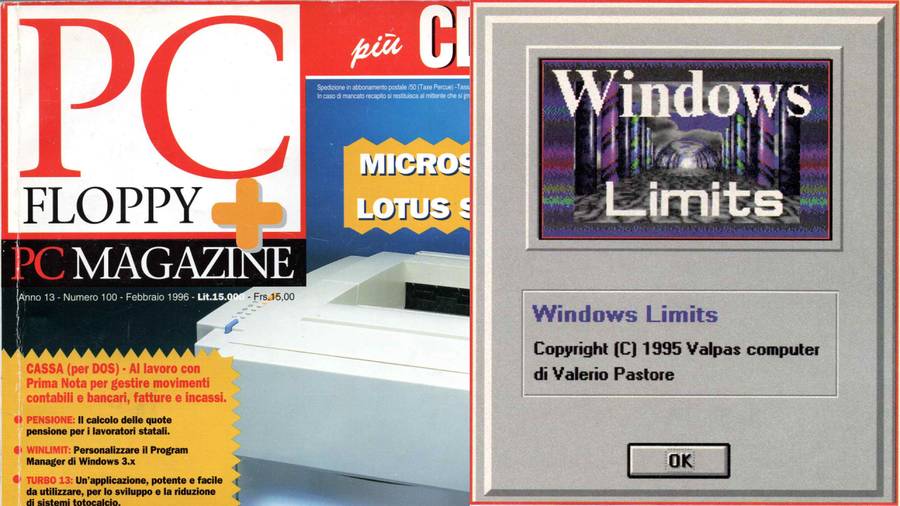
Windows Limits, Copyright 1995 Valpas computer di Valerio Pastore
Self-taught, seventeen years old. The idea was to write security software at a time when hardly anyone discussed security. That is how Windows Limits came about, the first endpoint protection program under the Valpas computer name.
It did one thing, and did it well: decide what a user could and could not do on a machine.
- Prevent configuration changes being saved
- Disable the Run command
- Prevent exiting Windows
- Block creating, deleting or renaming programs and groups
- All of it behind a password
Today that has a name: it is called endpoint hardening, and it is one of the pillars of corporate security. In 1995 it had no name at all, and the insight was a single one: if you cannot stop someone sitting down at a computer, you can decide what that computer lets them do.
It shipped with issue 100 of PC Floppy + PC Magazine, February 1996, announced on the cover.
That is where the rule comes from, and it still holds: simplicity and power are not opposites. A system nobody can operate protects nobody.
People entering this field now
There are also the people coming into information security now: professionals changing direction, younger managers, technical leads facing a board for the first time. They are taken one at a time.
It is also the reason the courses are taught in person, and only in person.